


What is Thumb triphalangeal deformity?
Thumb triphalangeal deformity (TPT) is a congenital deformity where the thumb has three phalanges instead of two. The extra phalanx varies in size, from small pebble to the size of normal fingers' phalanges. Its true incidence is unclear, but it's estimated at 1:25,000 live births. About two-thirds of TPT cases have genetic factors. Besides the extra phalanx, other deformities may be present.


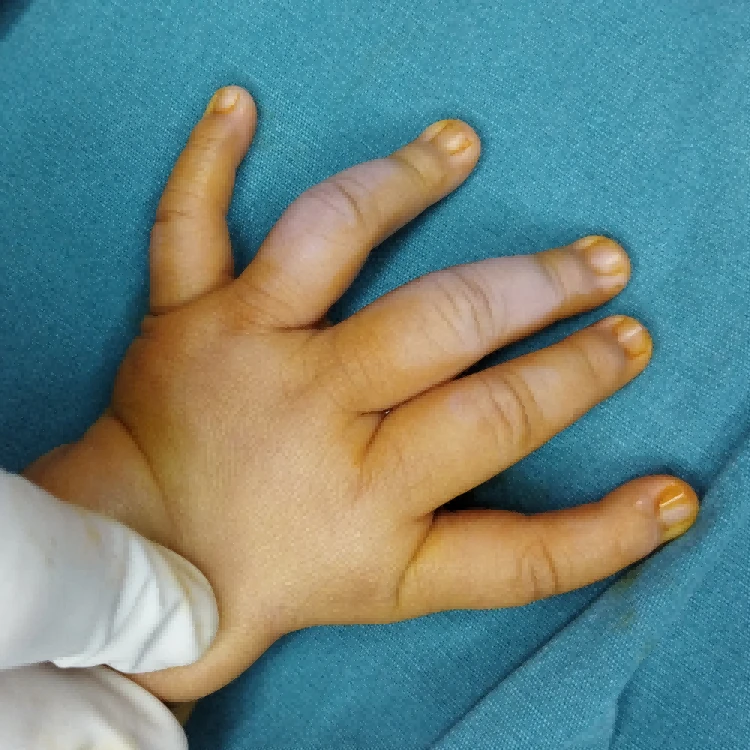
Clinical manifestations
Thumb Length and Shape
- Extra Phalanx Impacts Length: Thumb length varies with the size of the extra phalanx.
- Wedge or Trapezoid Shape: Thumbs often curve radially or ulnarly due to their shape.
Appearance Variations
- Thumb-like or Finger-like: Thumbs can resemble fingers more closely, aligning with the hand's plane instead of being pronated.
- Flexor Tendons Diversity: They may appear as shallow flexors, deep flexors, or a single long flexor.
- Thenar Eminence Issues: The first web may be normal or abnormal. The thenar eminence might be underdeveloped, deformed, or missing.
Joint Anomalies
- Excessive MP Joint Mobility: Due to thenar muscle deficiency, excessive mobility is common at the metacarpophalangeal (MP) joint.
- CMC Joint Defects: The carpometacarpal (CMC) joint might be underdeveloped, deformed, or absent. CMC joints have poorer development and function, especially in finger-like thumbs resembling the second CMC joint.
Associated Differences
- Pollicization Effects: Radial polydactyly tends to have better development compared to ulnar types.
- Syndromic Associations: May include cleft hands and radial defects.
- Lower Limb Anomalies: Congenital lower limb differences like polydactyly or syndactyly can occur.
Functional Challenges
- Opposition Deficiency: Many patients struggle with tasks like writing or picking up small objects due to lack of opposition.
- Radial Polydactyly Impact: Function of the best thumb is hindered by additional thumbs, especially with fused thumbs.
Adult Outcomes Without Treatment
- Study Findings: In 12 adults with TPT (23 hands), those who only had the radial polydactyl thumb removed fared well functionally despite some MP joint instability.
- Strength Levels: Their strength was significantly lower than average but adequate for daily activities.
- Quality of Life: Lower social function scores reflect psychosocial impacts. Aesthetic scores were lower than functional ones.
Surgical Timing Considerations
- Peer Teasing Motivation: Children with TPT often face bullying, prompting parents to seek corrective surgery before school starts.
- Rare Severe Functional Defects: Surgery is sometimes requested due to these issues but is not commonly the case.
Treatment
Surgical Objectives
- Improve Function and Appearance: The goals are to shorten thumb length, create a functional, stable, and well-aligned joint, and improve thumb positioning if necessary. This enhances hand and thumb function.
General Benefits of Surgery
- Functional Improvement: Mainly, surgery aims to improve thumb function.
- Aesthetic Enhancement: Another benefit is the improved appearance of the thumb.
Changes in Surgical Practices
- Historical Perspective: Previously, surgical treatment was not considered suitable for all TPT cases. Now, it is widely accepted that surgery can enhance both function and aesthetics.
- Untreated Cases: Some patients with TPT have not undergone surgery due to acceptable daily function but are concerned about the appearance of their condition.
Differing Views on Surgical Timing
- Wood's Recommendation: Suggests surgery between 6 months and 2 years old.
- Buck-Gramcko's Recommendation: Advises surgery before the age of 6 for all indications.
Surgical Techniques by Buck-Gramcko Classification:
- Types I and II: Typically involve removing the extra phalanx and reconstructing the ulnar and radial collateral ligaments if necessary.
- Type III: For smaller trapezoidal bones and children under 6, remove the extra phalanx and reconstruct the ulnar collateral ligament. Extend the radial collateral ligament only if there's residual angular deformity post-reconstruction. For those over 6, partially remove the extra phalanx, correct angulation, and perform distal interphalangeal (DIP) joint arthrodesis.
- Type IV: Usually involves osteotomy to reduce the metacarpal bone and DIP joint fusion, shortening by 1 to 1.5 cm. Often combined with metacarpal-level shortening, rotation, and abduction osteotomies to correct thumb position and length. Extensor tendons and intrinsic muscles are also shortened.
- Type V: May include "pollicization," which repositions, rotates, and shortens the misaligned thumb. First metacarpal osteotomy may be performed for rotation and realignment.
- Type VI: Typically involves removing most of the underdeveloped extra thumb and performing further surgery for triphalangeal thumb reconstruction based on the shape of the extra phalanx.
Hot Tags: thumb triphalangeal deformity surgery, China thumb triphalangeal deformity surgery doctor, Congenital Type A Ulnar Polydactyly Surgery, Pediatric Type B Accessory Digit Excision, Type B Accessory Little Finger Excision, Type B Ulnar Polydactyly Soft Tissue Correction, Wassel Type Thumb Polydactyly Surgery, Wassel Type V Thumb Polydactyly


